
As Above, So Below: An Introduction to the Hermetic Arts
Say the word "magic" and most people picture the same handful of things — a spell, a candle, a wand, something you do to the world to bend it toward you. That's not what this series is about, and it's not what Hermeticism is, even though the two get lumped together constantly.
Hermeticism is older than the aesthetic that's grown up around modern magical practice, and stranger in a much quieter way. It's a philosophical and spiritual tradition, rooted in texts attributed to Hermes Trismegistus, that treats the universe as a coherent, patterned whole — mind, body, spirit, and cosmos all operating on the same underlying principles, just at different scales. It's less a toolkit and more a lens. Once you're looking through it, tarot, astrology, and reiki stop looking like three separate hobbies and start looking like three different instruments tuned to the same note.
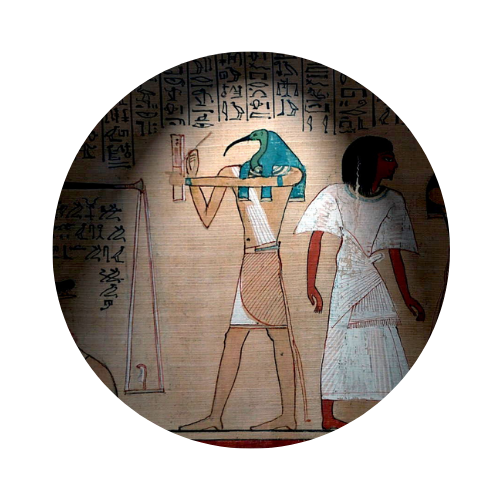
Hermes Trismegistus
What Hermeticism Actually Is
At its core, Hermeticism rests on the idea that the universe is orderly, not chaotic — that what happens in the small mirrors what happens in the large, and vice versa. That's the entire meaning behind the phrase "as above, so below." It's not a mood. It's a claim about structure. The stars move in patterns, and so do your thoughts. A single tarot card contains a whole cosmology, and so does a single breath. Nothing exists as an isolated event; everything is a smaller or larger echo of something else.
This is a tradition, not a vibe. It comes down through Hellenistic Egypt, gets absorbed into Renaissance philosophy, resurfaces in the Western Mystery Tradition, and eventually finds its way into a slim, controversial little book called The Kybalion, published in 1908 and still argued over by scholars today. Whatever its actual origins, the seven principles it lays out — Mentalism, Correspondence, Vibration, Polarity, Rhythm, Cause and Effect, and Gender — have held up remarkably well as a working framework, not because they're mystical trivia, but because they describe patterns you can actually observe once you know to look for them.
Where This Sits Relative to Tarot, Astrology, and Reiki
None of my other practices exist outside of this framework — they exist inside it. Tarot works because of Correspondence: a card can stand in for a life situation because the small (78 pieces of painted cardboard) genuinely mirrors the large (the shape of human experience). Astrology works because of the same principle applied to time and pattern — a birth chart is a snapshot of "above" that keeps echoing "below" for the rest of a life. Reiki works because of Vibration — the idea that everything, including the body, is energy moving at a particular frequency, and that frequency can be met, matched, and shifted.
I didn't learn Hermeticism as an addition to my other work. I learned it as the substructure that had been underneath all of it the whole time, whether I'd named it or not. That's usually how it goes for people who arrive at this material through tarot or astrology first — you find out later that you were already standing on it.


Why the Kybalion's Principles Still Hold Up
Skepticism about The Kybalion's actual historical claims is fair, and worth having. But the principles themselves don't rise or fall on whether they came from an ancient Egyptian sage or a trio of early-twentieth-century occultists writing under a pseudonym. They hold up because they're testable in the most unglamorous way possible: you can watch them operate. Rhythm shows up in your own moods before it shows up in any book. Polarity shows up the moment you notice that grief and love are rarely as far apart as people pretend. Cause and Effect shows up in literally everything, which is either the least mystical statement in this entire post or the most, depending on how you're feeling about the universe today.
This series isn't going to ask you to take any of it on faith. Each principle gets its own post, its own space to be examined rather than simply asserted. Consider this one the map before the walk — not the destination, just the shape of the terrain we're about to cover.
Dive into your daily magic or journaling - without having to look anything up!
Discover the energies of each day of October 2026 including numerology, associated chakras, Sun, Moon and other astrological energies, recommended crystals, and a Tarot prompt for each day. This is the perfect companion piece for anyone who journals either for magic or for meditation. Only available until October 22, 2026 when the November Grimoire Companion launches.