
Building the Ceremonial Altar: Tools, Space, and Intention
Four posts in, we've been dealing almost entirely in principle — mind, pattern, pulse, cycle. This one turns a corner. An altar is where those principles stop being ideas you nod along to and start becoming something you actually build with your hands. It doesn't need to be elaborate. It needs to be intentional, which is a different requirement entirely.
Space Before Objects
Before anything goes on an altar, the space it occupies has to be chosen on purpose, not just found. This can be a dedicated table, a shelf, a windowsill, even a portion of a larger surface that gets cleared and reset each time you work. What matters isn't square footage. What matters is that the space is claimed — set apart, even briefly, from the ordinary function the rest of the room is doing.
This is Correspondence at work before you've placed a single object: a small, deliberately bounded space becomes a working model of the larger cosmos you're engaging with. That's not a metaphor you're supposed to appreciate from a distance. It's the actual mechanism. The altar is "above" made small enough to work with "below," and the boundary around it — a cloth, a shelf edge, a corner of a room turned to face a different direction — is what lets that correspondence hold.
Orientation matters more than most people expect going in. Many traditions within the Western Mystery Tradition work with the four cardinal directions and their elemental associations — east for air, south for fire, west for water, north for earth — and setting an altar with some awareness of that orientation, even loosely, gives the space a structure to organize around rather than leaving it to feel arbitrary.
Tools: What to Include and Why
A working altar tends to gather a small, functional set of tools rather than a large decorative one. None of these are required in some fixed, universal sense — but each one earns its place by representing a piece of the whole system, which is the actual point of having them there at all.
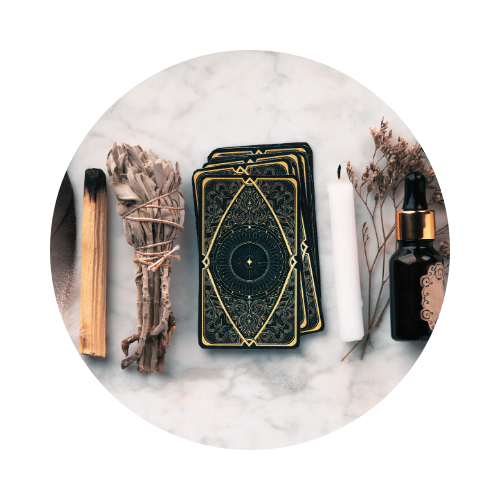
A candle for fire and for the presence of will and intention. A small dish of water, or a chalice, for the element of water and for receptivity. Incense, or simply a feather, for air and for the movement of breath and thought. A stone, salt, or a small dish of earth itself, for grounding and for the body. Many practitioners add a blade or a wand to direct energy, and a pentacle or disk to represent manifestation — though these can be improvised rather than purchased, and improvised well is not a lesser version of the real thing.
Beyond the elemental tools, this is also where a grimoire belongs, open and ready, not tucked away on a shelf elsewhere. Recording what happens at the altar — the working, the date, the state you arrived in and the state you left in — is part of the practice, not an administrative task attached to it. A tool used without a record is a tool whose pattern you'll have to rediscover from nothing next time.


Intention Is the Actual Ingredient
Here's the part that's easy to skip past: none of these objects do anything on their own. A candle is wax and wick until intention is placed behind lighting it. A stone is mineral until it's been chosen, deliberately, to represent something specific to you in that particular working. This is Mentalism again, still doing its quiet work underneath everything — the objects on an altar aren't the source of the working. They're a focus for a mind that was always the actual source, all along.
This is also why an altar built entirely from a shopping list, with no thought behind any of it, tends to feel inert even when every object on it is technically "correct." And a plain altar, assembled with real attention — a stone from a specific walk, a candle chosen with actual care, water poured with a clear intention behind it — will outperform an expensive one every time. The tools are a scaffold for focus. They were never the working itself.
The next post walks through what actually happens once the altar is built and the space is set — the shape of a ceremonial working itself, from opening to close.
Dive into your daily magic or journaling - without having to look anything up!
Discover the energies of each day of October 2026 including numerology, associated chakras, Sun, Moon and other astrological energies, recommended crystals, and a Tarot prompt for each day. This is the perfect companion piece for anyone who journals either for magic or for meditation. Only available until October 22, 2026 when the November Grimoire Companion launches.