
Paroketh: Rending the Veil
For centuries, a single curtain stood between humanity and the Divine Presence. I open it with four Hebrew letters and my own two hands.
In the ancient Tabernacle, and later in the Temple in Jerusalem, a great curtain hung before the innermost chamber. Behind it was the Holy of Holies, the dwelling place of the Divine Presence. Only one person ever passed through it: the High Priest, once a year, on the Day of Atonement.
The Hebrew name for that curtain is Paroketh. It means veil.
Every time I rend the veil in my own ritual work, I remember that for most of human history, this threshold was forbidden. Crossing it isn't casual. It's the moment the ritual stops being preparation and becomes real.
The Veil Between the Worlds
The Book of Exodus describes the veil in detail. It was woven of blue, purple, and scarlet thread on fine linen, with cherubim worked into the fabric to stand guard over what lay behind it. When the Gospels describe the moment of the Crucifixion, they tell us the Temple's veil was torn in two, from top to bottom, and the way into the holiest place was opened.
The Hermetic Order of the Golden Dawn carried the veil into its mystical map of the soul. On the Qabalistic Tree of Life, the Veil of Paroketh separates the lower spheres of everyday personality from Tiphareth, the radiant center of the Tree and the seat of the higher Self. Crossing it marked the passage from the Order's Outer grades into its Inner Order of Adepts. Initiates learned a sign for opening the veil and another for closing it, and they spelled the word letter by letter: Peh, Resh, Kaph, Tav.
The veil, in other words, is the line between the self I bring to the altar and the self I'm reaching for.
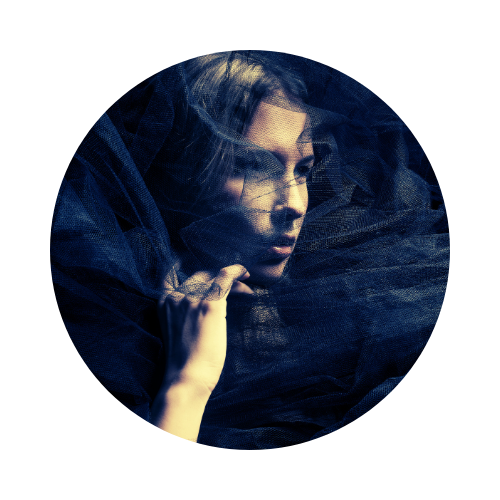
Paroketh: Rending the Veil between the Seen and the Unseen
Why Hebrew?
Why use Hebrew in my workings when I don't speak it anywhere else? Because in the Qabalistic tradition, Hebrew isn't only a language. Each letter is a living force, a number, and a symbol. The Sefer Yetzirah, one of the oldest texts of Jewish mysticism, teaches that creation itself was formed through the twenty-two letters of the Hebrew alphabet.
When I intone a Hebrew word in ritual, I'm not translating an idea. I'm building it one sound at a time, letting each letter vibrate through the body and into the space.
Paroketh shows why this matters. Its four letters are all among the seven "double letters" of the Hebrew alphabet, and in the Golden Dawn system each one is tied to a planet: Peh to Mars, Resh to the Sun, Kaph to Jupiter, and Tav to Saturn. As an astrologer, I love that. The word for the veil is spelled with courage, illumination, expansion, and structure. The veil isn't opened by wishing. It's opened with deliberate force.
That's the real purpose of Hebrew in my practice. It slows me down and demands precision. Nothing about it is automatic, so everything about it is intentional.
Crossing the Threshold, Together
Rending the veil is one of the most meaningful moments in ritual, and it deserves to be approached with care. The Hebrew intonation, the gesture, and the shift in awareness that follows are best learned first under guidance, so that when the veil opens, you're ready for what you see.
Ritual Workings are available to anyone who has previously had a Personal Reading with me. If your reading has called you toward deeper clarity, we can learn to part this veil side by side.
Rending the Veil
I stand facing my altar with my arms stretched straight out in front of me, the knuckles of both hands pressed together. Then I intone the four letters, drawing out each one:
Peh (pronounced "pay"). Resh. Kaph. Tav.
As the word takes shape, I draw my hands apart, opening an unseen curtain wide enough to walk through. What I'm asking for is simple and enormous: to see clearly, so that everything I do in my work is intentional, powerful, and purposeful.
Then I declare it: "The veil is open and our workings have begun."
Some practitioners mark this moment with a sharp clap; some ring a bell. Either way, the sound confirms what the gesture has done.

Stepping Through
I add one more step of my own. With the veil open, I step forward to my altar and speak:
"May my guides, my angels and my ancestors be present with me. May I recollect any dreams, memories or visions that will benefit my work. And may I act in accordance with my highest, most divine self."
This is where the veil becomes personal. Passing through it doesn't mean leaving my life behind. It means bringing everyone who walks with me, seen and unseen, into the room.
The High Priest crossed the veil alone, once a year, carrying the weight of a whole people. I cross it on an ordinary morning, carrying my guides, my ancestors, and whatever I've been given to see. The veil was never meant to keep us out forever. It was meant to teach us to arrive ready.
And at the conclusion of my work, I close the veil as I prepare for a final protection ritual.
A ritual working with Divinely Designed is only offered following a Personal Reading, if recommended. A Ritual Working will allow you to partner in magic with Divinely Designed and may include crystal gridwork, magic workings, advanced readings of Tarot or Oracle Cards, and other rituals based on Western Mystery Traditions.