
The Qabalistic Cross: Where Every Working Begins
Four points of the body, five Hebrew words, and a pillar of light. It's the simplest ritual I know, and the one I would never skip.
Before I light a candle, before I cast a circle, before I ask anything of the unseen, I stand still and draw a cross of light through my own body. Every ritual working I do, for myself or for a client, begins here.
The Gesture
The Qabalistic Cross takes less than a minute. Facing east, I imagine a sphere of brilliant white light just above my head. Then I draw it into my body, vibrating one Hebrew word at each point:
Forehead: Ateh (Thou art). The light is drawn down from above.
Breast: Malkuth (the Kingdom). The shaft of light descends through me and into the earth beneath my feet.
Right shoulder: ve-Geburah (and the Power).
Left shoulder: ve-Gedulah (and the Glory). A beam of light crosses from one shoulder to the other.
Hands clasped at the heart: le-Olam, Amen (forever, amen).
When it's done, I stand at the center of an equal-armed cross of light. The vertical beam joins heaven to earth, and the horizontal beam balances strength with mercy.
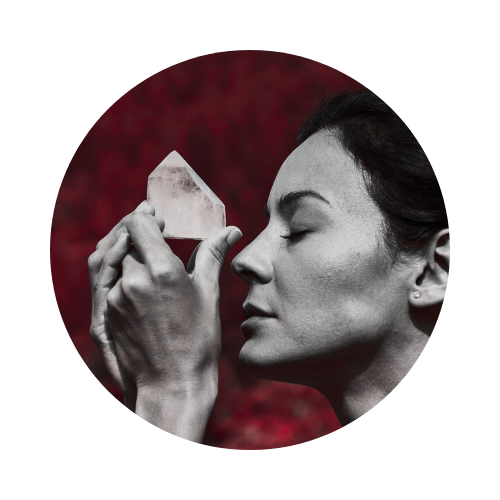
I often use a crystal point in my Qabalistic Cross ritual
Where It Comes From
If the words sound familiar, they should. They're the closing line of the Lord's Prayer, For thine is the kingdom, and the power, and the glory, for ever, rendered in Hebrew. That line itself echoes King David's prayer in 1 Chronicles 29:11.
In the 1850s, the French occultist Éliphas Lévi argued that the sign of the cross was a Kabbalistic gesture long before it was a Christian one. The Hermetic Order of the Golden Dawn, founded in London in 1888, took up that idea and gave the Qabalistic Cross its modern form, placing it at the opening and closing of its foundational rituals. For decades it was an initiate's secret. Then Israel Regardie published the Order's teachings between 1937 and 1940, and the Cross passed into the hands of practitioners everywhere.

What It Means
Each point of the Cross corresponds to a station on the Tree of Life. The light above the head is Kether, the Crown, the first emanation of the Divine. Malkuth is the Kingdom, the physical world where we live and work. Geburah is Severity, the power to cut away and defend. Gedulah, also called Chesed, is Mercy, the power to give and to build.
So in one breath I'm saying: The Divine is the Crown and the Kingdom, the Strength and the Mercy, now and always. And I'm saying it with my body, not only my voice. The Cross doesn't ask the Divine to come closer. It recognizes that the light already runs through me, crown to feet, and it brings me into balance before I reach for anything else.
That's why it comes first. A working built on an unbalanced foundation leans.
It's also why it comes last. When the work is finished, I close with the Lesser Banishing Ritual of the Pentagram, which begins and ends with this same cross of light. The first gesture and the final one are the same, and I return to where I started, sealed and whole.
Begin with Guidance
On the page, the Qabalistic Cross looks simple, and in a sense it is. But the visualization, the vibration of the Hebrew, and the feeling of the light moving through the body are far easier to learn with someone beside you than from a set of written steps. Ritual and ceremony are always best approached first through guidance.
Ritual Workings are available to anyone who has previously had a Personal Reading with me. If your reading pointed you toward deeper work, this cross of light is where we'll begin together.
Have you ever felt the moment a room goes quiet before something sacred begins? That's the moment the Cross is made for.
A ritual working with Divinely Designed is only offered following a Personal Reading, if recommended. A Ritual Working will allow you to partner in magic with Divinely Designed and may include crystal gridwork, magic workings, advanced readings of Tarot or Oracle Cards, and other rituals based on Western Mystery Traditions.