
Tarot
The Tarot is a pack of playing cards that has existed since the mid-15th century. Originally designed as Italian playing cards called Tarocchi, they quickly gained use as divination tools and trademarks of the occult. There are also theories that an ancient Egyptian set of cards known as the “Book of Thoth” inspired the modern Tarot deck.
These illustrated cards depict various figures and influences that may be interpreted, almost like a story, for the querant – the person asking a question. Because Tarot, unlike Oracle Cards, are universal, that means that it is easier to understand the meaning and possible interpretations for Tarot readings than for Oracle readings. The wisdom is accessible for anyone who wishes to learn Tarot.
Initially, Tarot cards were hand painted. They only were mass produced after the invention of the printing press. Today, there are tarot decks produced that resemble some of the earliest editions although the most common ones used are either a specific deck originally created in 1910, or interpretations inspired by that same deck. That deck, the Rider-Waite-Smith one, we’ll talk more about here.
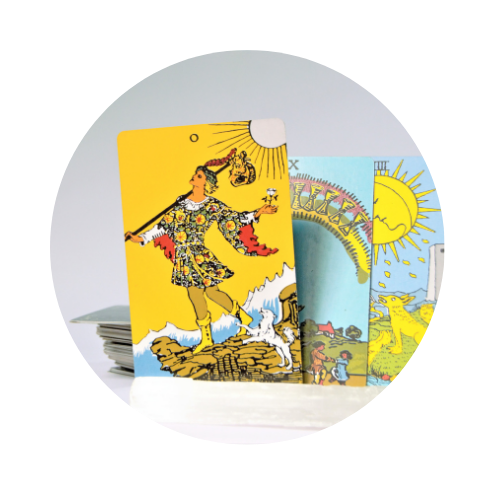
The Tarot saw its greatest revival during the 18th century when it became one of the most popular card games throughout Europe. During the last two decades of the 19th century, the spiritualist movement also boosted its popularity and at the end of the Victorian era, the Rider Waite Smith deck was created.
Dr. Arthur Edward Waite was a scholar and occultist who wrote a number of books including “The Holy Kabbalah.” The first cards by Waite were published in 1909 by William Rider and Sons of London. A second edition was published the following year which featured illustrations by Pamela Colman Smith, a British suffragette and graphic artist who went by the name Pixie and was a member of the Hermetic Order of the Golden Dawn. Like many works of magic, the melding of masculine and feminine strengths proved quite fortuitous and it is the deck created by Waite featured artwork by Smith that is the most recognizable and most popular Tarot deck on the planet.
There are two sets of cards in the Tarot: the Major Arcana and the Minor.
The Major Arcana (known as the greater secrets or trump cards) consists of 22 card without suits.
The Minor Arcana (the lesser secrets) consists of 56 cards, divided into the four suits with 14 cards each.
Wands / Fire
Swords / Air
Cups / Water
Pentacles / Earth
Each suit has a King, Queen, Knight and Page. You can sometimes interpret the King to be a man, the Queen as a woman, the Knight as a young man or boy and the Page as a young woman or girl, if you seek an answer that has a WHO question. Additionally, each suit has an Ace (representing 1) along with cards 2-10.

The specific symbology that you see on each card and the artwork all means something, at least in the Rider-Waite-Smith versions. That is why I suggest if you want to learn Tarot, use this deck. There are also versions of this deck that are in black and white and some new practitioners will actually color in their own cards as a means of getting to know them.
Tarot decks differ from Oracle Decks in that Tarot follows a pretty clear set of icons and images. While some decks may be more artistic or creative than others, they basically use the same meanings. Oracle Decks are more open to the interpretation of their creators.
Tarot is one of the four quadrants of the Western Mystery Tradition (along with Theurgy, Astrology and Alchemy) and so is a basic tenet of the magic practice I work with. But anyone can use Tarot. The more you use Tarot, the more you will understand it and the more meaningful it can be.
Some people can only pull cards for other people. Some people are able to do readings for themselves. The greater your intuition is, the more interpretations you will find, and the more you really intimately known Tarot the higher your degree of clarity will be.
So, how do you work with the energies of Tarot? There are many ways:
· By understanding the conventional meanings of each of the cards and slowly over time learning to recognize their faces and images and elements, and then to adapt your understanding with each querant (the person asking the question or receiving the reading).
· By using other elements of magic to advance your understanding. Theurgy (the rituals and practices performed with the intent of invoking or evoking of deities or spirits, specifically with the goal raising ones own spiritual powers. I want to talk about two very powerful words here:
Henosis: The purist of the union with the self, particularly the divine self (the self that is God, the God that is self)
Gnosis: The secret knowledge of humanity’s real nature as divine, the divine spark within humanity that releases us from earthly existence.
Together, Henosis and Gnosis form a consenting duo that allows us to acknowledge what is divine within each of us while seeking that which will bring us into union with that most divine self, our highest divine genius.


Other ways to learn Tarot and be comfortable doing readings:
· Work with your spirit guides. Ask them for guidance. Ask them to show you which card represents them, or you, or the situation.
· Work in dreams. As you become more adept at using Tarot, you may find yourself dreaming of some of the imagery of particular cards.
· Just practice, practice, practice. Start by drawing a card for yourself every day and just slowly getting to know each of them. Later, you can create spreads of two or more cards (there are many options out there).
· Later, you can consider doing readings for others. Do not feel like you have to be an expert to do this. Massage therapists require hundreds of hours of free practice on willing bodies in order to achieve the credits required to become licensed. Tarot practitioners must learn to listen to the cards and interpret them to different querants and the best way to do that is to offer your services to others. I suggest doing that for free, unless you have had years of knowledge and experience with Tarot.
· Continue learning, growing, and incorporating the Tarot into your daily workings.
· Once you learn Tarot, choose a card for yourself. It may be based on numerology (your date of birth for instance) or astrological sign. Once chosen, place that card (or an image of it) somewhere where you will see it as you do magic.
· Read about Tarot. There are many excellent books.
And follow us here of course, including signing up for our weekly email and at Facebook and Instagram!
Dive into your daily magic or journaling - without having to look anything up!
Discover the energies of each day of October 2026 including numerology, associated chakras, Sun, Moon and other astrological energies, recommended crystals, and a Tarot prompt for each day. This is the perfect companion piece for anyone who journals either for magic or for meditation. Only available until October 22, 2026 when the November Grimoire Companion launches.