
The Monster Was Never The Witch: A History Of Who We Decide To Burn
Part 6 of 6 in the Monsters Among Us series
Between 1400 and 1782, somewhere in the range of 40,000 to 60,000 people were executed across Europe on charges of witchcraft. The vast majority were women — poor, older, widowed, unmarried, or simply unpopular with a neighbor who had something to gain from their land or their silence. The trials rarely required actual evidence of harm. They required suspicion, a confession extracted under torture, and a community frightened enough to need someone to blame for the crop failure, the dead child, the plague that had no other explanation available at the time. The witch wasn't a real threat. She was a solution to an unbearable question: why is this happening to us, and who can we make pay for it.
Salem, in 1692, gives Americans their own version closer to home — nineteen people hanged, one man crushed to death under stones for refusing to enter a plea, and a community that spent the better part of a year accusing its own members based on the testimony of children, neighbors with old grudges, and a fear that metastasized faster than anyone could slow it down. By the time it ended, the people doing the accusing weren't pursuing witches. They were pursuing the safety of being on the inside of the fear instead of underneath it.
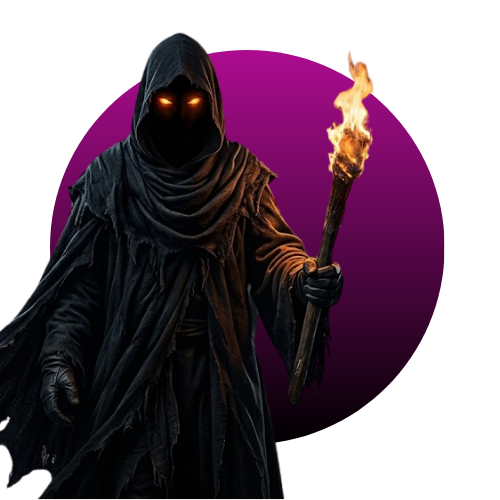
The Witch Hunter leads the mob…
This is the part the monster movies never quite capture, because monster movies need an actual monster. The witch trials had no werewolf, no vampire, no creature stitched together in a lab. They had ordinary people, afraid, looking for somewhere to put the fear, and finding it in whoever was already standing slightly outside the group.
That's the inheritance this final post has to sit with. Not a fictional villain we can hold at a safe distance, but a documented, repeated, historical pattern of communities turning on their own — and a pattern that hasn't actually stopped, even though the methods have changed and the word "witch" mostly stays in the history books now.
It shows up in spiritual communities today as the swift, total expulsion of someone who asked an uncomfortable question about a teacher's conduct. It shows up as a private message chain deciding, collectively and without the accused present, that someone's "energy" can no longer be trusted near the group — a charge with no defense available, since it requires no evidence and admits no rebuttal. It shows up online as the pile-on that arrives before anyone has gathered the actual facts, because the speed of the condemnation has become its own kind of proof, and waiting to learn more reads, to the crowd, as suspicious in itself. The torches changed shape. The instinct underneath them — find someone to blame, move fast, do not be the one left standing near the accused when the fire starts — is exactly the one that hanged nineteen people in a Massachusetts village over a single terrified year.


It's worth being honest about something uncomfortable here: metaphysical and wellness spaces are not exempt from this pattern, and in some ways are unusually vulnerable to it. A community organized around concepts like energy, vibration, and alignment has a ready-made vocabulary for excommunication that sounds spiritual rather than political. "Their energy isn't aligned with this space anymore" can mean someone caused real harm and needed to be asked to leave. It can also mean someone disagreed with the wrong person at the wrong time, and the group found a way to make the disagreement sound like a spiritual deficiency rather than what it actually was.
The hard work — the work this whole series has been circling, post after post — is learning to tell the difference. Naming real harm and protecting a community from it is necessary, sometimes urgently so; the Charlatan in this series is exactly the kind of figure a community has every right to name and exclude. But there's a difference between that accountability and the witch hunt, and the difference usually comes down to whether the process allows for evidence, for the accused to be heard, for proportionality, and for the possibility of being wrong. The witch trial, historically, allowed none of these things. Neither does its modern descendant.
Three Questions Before You Join The Mob
1. Have I heard the accused's account, or only the account of the accuser?
A claim repeated confidently by many people is not the same as a claim that has been examined. Notice if you've actually heard both sides, or just one side many times.
2. Am I afraid of the person, or afraid of being seen defending them?
These produce the same silence but mean very different things. The second one is usually the witch trial talking, not your judgment.
3. Does the proposed consequence match the actual evidence?
Real accountability is proportionate. If the punishment was decided before the facts were, that's worth noticing — and naming, even quietly, even just to yourself.
There is no monster movie to close this series with, no creature in a cape or a mask to point at and say that's the danger, right there. The danger, in this final post, was always the crowd — which means it was always, at least potentially, us. The witch hunters in 1692 did not think of themselves as villains. They thought of themselves as people protecting their families from something genuinely terrifying. That conviction did not make them right. It only made them certain, and certainty turned out to be the most dangerous ingredient in the entire affair.
The communities that learn from this don't become communities with no standards at all. They become communities willing to slow down long enough, even once, to ask whether the fire is warranted before anyone lights it.
That single pause is the whole difference between accountability and a hunt.
This concludes the Monsters Among Us series. Read from the beginning:
Dive into your daily magic or journaling - without having to look anything up!
Discover the energies of each day of October 2026 including numerology, associated chakras, Sun, Moon and other astrological energies, recommended crystals, and a Tarot prompt for each day. This is the perfect companion piece for anyone who journals either for magic or for meditation. Only available until October 22, 2026 when the November Grimoire Companion launches.