
Egyptian Magic
Many modern traditions in magic, including those derived from European roots and the Mystery Traditions, are directly descended from the ‘Cradle of Magic’ that is Ancient Egypt. In its day, Egypt honored a magic tradition known as Heka, which loosely translates to ‘Art of the mouth’ although a more artful description would be ‘Magical or Meaningful Speech’.
Ancient Egyptians lived in a world that attempted to infuse magic and meaning in every aspect of life. Birth, death, love, power, agriculture, and community. Those famous hieroglyphs painted on the walls of temples and tombs, were a form of Heka – the Ancient Egyptians believed that the written word held power over whatever it described. If it was the name of someone deceased, it had the power to raise them from the dead. If it was the name of an enemy, it had the power to obliterate them.
Heka not only described their magic, it was a form of power itself – a power over chaos, over destruction, and over uncertainty.
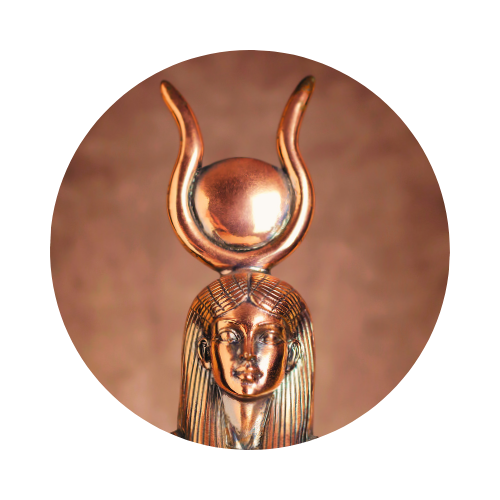
Isis and Egyptian Magic from Divinely Designed Astrology Magic Light
One of the figures commonly associated with Heka is that of Tehuti – also known as Thoth.
Thoth is one of the earliest Egyptian Gods, self-created at the beginning of time along with his wife, Ma’at. Thoth, described as an ibis-headed human, carries a pen and a scroll to record all things. He is known as the inventor of the written word, of medicine and magic, and is considered the scribe of the Underworld, who renders his written verdict upon the deceased to restore balance.
The famous Egyptian Book of the Dead is said to be written by Thoth/Tehuti. Thoth is also considered the father of the Tarot and the 365-day yearly calendar that we continue to observe today. Thoth is the measurer of time, and the inventor of mummification.
Notably, among the large pantheon of Gods and Goddesses in Egyptian Lore, all of them had human origins. Meaning, that they first had human form and then ascended to Godlike status. It imbues magic, to this day, because it provides that blueprint for our own ascencion. For us, it isn’t to a God status but rather to our own Higher Divine Genius.
The most influential myths about Egyptian Gods in the world of magic today are ascribed to Isis, Apophis and Osiris. I mentioned them briefly during the Sacred Words blog because their leading letters – I A O are critical in invocation ceremonies and other modern rites.

Reiki is an excellent tool for stress reduction and clarity. We specialize in assisting clients who are dealing with PTSD, addiction/recovery and generalized anxiety. Available live or remotely.
Isis – Apophis – Osiris. IAO or IAΩ is a God-name of the early-Gnostics, and can be considered a Greek form of the Tetragrammaton (the fourfold unutterable name of God). As a magical formula it depicts a three-fold process of creation-destruction-regeneration or birth-death-resurrection: three principles that, on a certain level, cannot exist apart from one another.
Isis is the Great Mother. Apophis is the Great Serpent, the destructive principle, and represents Death. Osiris is the regenerative principle, representing Resurrection, not in the sense of a coming-back-as-what-was, but Resurrection in the sense of awakening anew through transformation.
Most scholars know the tragic story of the death of Osiris. His evil brother Set murdered him. Set is the destructive aspect that the alchemical principal must undergo, and thus be reborn into a new and purified creation. That is exactly what happened to Osiris.
But Isis / Apophis / Osiris and IAO is not only an ancient Egyptian story of creation, death and resurrection – it is actually a magic formula in the Ancient Mystery Traditions, a powerful process of transformation that unlocks the keys of magical power and immortality. Some of the mythology of Jesus Christ was borrowed from the early myths of Isis, Apophis and Osiris including the resurrection story.
Osiris (the God of Life, Death, fertility and agriculture) is part of a trinity of Gods in Egyptian tradition including Isis (the Divine Mother) and Horus (their son, conceived by Isis after Osiris was murdered and chopped into many pieces, and she found the one critical part she’d need to become pregnant and with that, conceived Horus).
Osiris conquers death (both in his parentage of Horus and as the first mummy, the anointed one who ascends) and he ultimately paves the way for everyone else’s immortality. Immortality is a key theme of magic – the reason we do the work we do to raise and elevate ourselves to our higher divine genius is in the hopes of everlasting life. As magicians, we understand that everlasting life is an alchemical process intended to harness the power we create in this life and carry it – the Merkaba or chariot – into the next.
The Osiris Myth is really about the imagined phases of the Sun – Son/Sun and how it aligns with our view and longing for immortality. Set – the evil brother – represents chaos and disorder and evil. But Osiris (and Isis and Horus) reflect the heroes that overcome death and restore order over the chaos.
Resurrection is essential to that myth as reflective of the sun’s ascents and descents. Judgment of the soul, escape from death through resurrection, personal immortality by mimicking Osiris, such as by mummifying the corpse — these were primary themes of Egyptian religion for some three thousand years!
Now, let’s look at the Christian narrative: God the Father impregnates a virgin bride (so fathers a child but not in conventional ways), who gives birth to an anointed one. Christ then sacrifices himself to save us from sin, or from our chance at immortality. Both the Christ and Osiris myths revolve around the same fundamental problem even though they differ in other ways. The myth of Osiris was already known in ancient Judea at the time of Christ’s birth. Early Christian writers repurposed the myth of Osiris, the theme of triumph over death via a magical resurrection and framed it in a Jewish historical context, particularly the apartheid Roman occupation of Judea which led to the destruction of the Temple at the start of Christianity.
Jesus’s mother Mary is seen as a miraculous, holy virgin, just as Isis was worshipped as a goddess. The image of Mary nursing Jesus is borrowed from the Egyptian icon of Isis nursing Horus.
Jesus is betrayed and killed by the actions of Judas (his dear friend and almost brother), just as Osiris is betrayed and killed by Set (his actual brother)
I mention the comparisons between Ancient Egyptian magic and Christianity, and between Osiris and Christ because Christ himself continues to influence the world of magic in our pursuit for immortality.
Returning to the idea of Heka magic, it centers again around the written word. Some of those same words wind up in the Mystery Traditions and other schools of magic.
Libraries were important centers of magical learning in Ancient Egypt. Temple libraries in individual communities functioned as higher education for priests and leaders.
I’m going to discuss more about libraries in a moment. First, I want to talk about Nuit.
Nuit (or Nut) is the Goddess of the Sky, the heavens and the stars, the eternity of the Universe. She is keeper of the unconsciousness and protector of all who journey through the land of the dead. Nuit is Goddess of Resurrection and eternal life. We are the stars – the sparks of light – in her night sky and she represents the promise that all paths lead to her.
Nuit is such an important figure in modern magic because she represents the darkness that partners with the light. If Osiris represents the Sun (and the Son), Nuit is our Moon. Light does not exist without darkness. Darkness and light are partners to each other, creating space for each other, allowing each to exist and to thrive. Darkness does not vanquish light and light does not obliterate the dark. They each feed off of each other, and we must learn to do the same.
We must honor the light and the dark within each of us. Don’t be afraid of the dark – I promise you that evil hides in bright places as much if not more than it hides in darkness. Embrace the polarity of light and dark in our world, and in you. This isn’t about worshipping darkness or elevating its status to more than what it is. It is just acknowledging that it is part of life, part of the light, and part of each of our journeys.
Nuit was a central figure to Aleister Crowley, of the Hermetic Order of the Golden Dawn and the organization he founded, Thelema, both of which exist today. Thoth was also important to Crowley, who created a Tarot deck called the Thoth deck. We’re going to talk about Crowley in future blogs, to explore this highly influential but controversial figure.
In Ancient Europe, magic was divided into good, natural and demonic. This same distinction did not exist in Ancient Egypt. Light was part of darkness, death was part of life. Magic, Medicine and Religion were interchangeable. Priests used magic, medicine and religious healing to treat sickness. They invoked all kinds of supernatural beings, including some that we might think of as demonic. Their invocations did not mean that the afflicted person became possessed by this demon. It just meant that the priest called upon the demon to do what it does, in service of healing their patient.
Egyptian theology did not ascribe many supernatural beings as evil. Invoking them was not dangerous, nor was there a stigma even to worshipping them. It was simply a question of determining what a spirit or entity could do, and the intention of those who choose to call upon them in that service.
How can we use darkness to create light, to create life, to create liberty? That is the question that Nuit and other entities of the dark offer to us. They are vehicles of energy to be used either for light or for dark, not spirits that are going to take over our souls. Magic, while it is equally about light as it is dark, is still subversive in that it honors what is in ways that religion, deeply fearful of anything it cannot overpower and frankly, monetize, can not.
The Great Library of Alexandria was one of the most important and largest libraries in the ancient world. It acquired many papyrus scrolls – possibly as many as 400,000. People came from all over the world to study at Alexandria and although the rumor for ages was that the library burned, it actually declined over the course of many centuries. Some of the library, however, is believed to have burned in later years by Julius Caesar during his civil war in 48 BC. Libraries are houses of the holy word, and modern magic continues to honor the traditions of Alexandria by sharing information including between different sects and schools of magic. Much like the great Temple at Jerusalem, there are some beliefs that Alexandria will rise again – allowing for everyone and anyone to access the highest levels of information stored in this etheric library.
Ancient Egypt and its traditions continues to inform the modern world of magic in everything from the clothing we wear, the furniture we use (including altars), our temples, the stagecraft of ritual work, and some of the rites themselves.
Several of our magical rituals have their roots in Egyptian Magic, including the Solar Adorations. I’ll be recording the Solar Adorations rituals (all four) for an upcoming video. The Solar Adorations continues the tradition of recognizing the Sun as the center of our daily life, at dawn, noon, dusk and midnight, the Sun/Son of God that lights our skies.
Many modern magicians particularly during the golden age of the spiritual movement (late 1800s and early 1900s) were fascinated with Egyptian lore and tradition. If this era is of interest to you, I hope you’ll join future ritual workings in which we dive deeper.