
Neptune in Sagittarius: The Dream Went Looking For A Guru
Sagittarius doesn't stay home. It's the sign of the pilgrim, the philosopher, the one who leaves to go find meaning somewhere else entirely. Hand that restlessness to Neptune, and you get fourteen years of an entire culture packing its bags in search of enlightenment — some of it real, some of it a very expensive con, and almost none of it fully sure which was which.
Neptune first touched Sagittarius in January 1970, slipped back into Scorpio that May, and settled into Sagittarius for good on November 6, 1970 — holding through November 21, 1984, with a final dip into Capricorn in June of that last year before crossing over for keeps. The very start of this season overlapped with the closing chapter of the previous one: Charles Manson's trial concluded in January 1971, with his conviction and death sentence (later commuted to life in prison) landing right at Sagittarius's opening gate. Worth naming, briefly, as the dark hinge between seasons — but not the story this one is actually telling.
The Border Checkpoints Came Down
This is the season the West went looking for the East in earnest, and largely found it — though not without getting burned first. The Beatles' famous 1968 pilgrimage to study under Maharishi Mahesh Yogi had already curdled by the time this season opened, once allegations of impropriety surfaced and disillusioned the very fans who'd made him a household name; John Lennon's bitter "Sexy Sadie" was reportedly written about exactly that fallout. Sagittarius doesn't stop searching just because the first guide turned out to be false, though. Transcendental Meditation kept spreading anyway, taught in corporate offices and college dorm rooms alike. Hare Krishna temples opened in cities that had never seen orange robes and shaved heads on a street corner before. Yoga started migrating out of immigrant communities and into strip-mall studios. Buddhist and Hindu philosophy stopped being academic curiosities and started being lived practice for people who'd grown up in entirely different religious traditions.
None of this happened because the East arrived — it had always been there. It happened because Neptune in Sagittarius gave a generation of Westerners permission, for the first time at real scale, to actually go looking, even after their first guide let them down.
Neptune in Sagittarius: I really want to see you
The Avatar Of The Era
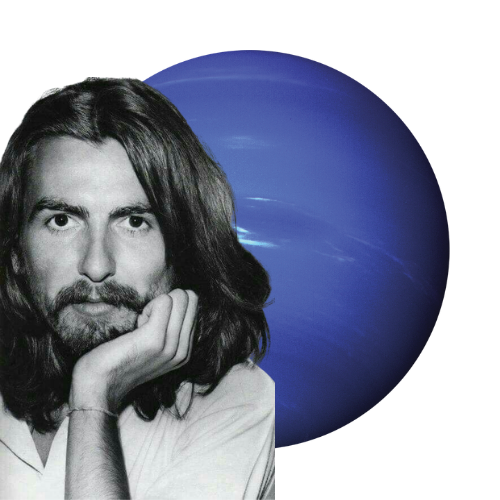
Robin Williams's Mork from Ork is a fun instinct — an alien dropped into an unfamiliar culture, wide-eyed, funny, faintly otherworldly, trying to make sense of Earth from the outside. That's real Sagittarius-Neptune texture, and it's worth keeping as a footnote for exactly that reason. But the sharper avatar here is George Harrison. Where his former bandmate walked away from the Maharishi disillusioned, Harrison kept going — deeper, and for longer than anyone expected. "My Sweet Lord," a 1970 chart-topper built around a Hare Krishna chant, put Eastern devotional practice directly onto Western radio. The Concert for Bangladesh in 1971 fused his spiritual worldview with global humanitarian action on a scale no one had attempted before. And in 1973, he personally donated the property that became Bhaktivedanta Manor, still one of the major Hare Krishna temples in the West today. He's the one figure of this era whose embrace of the East wasn't a single trip or a passing phase — it was the rest of his life.

When The Search Curdled
Sagittarius trusts the journey. It doesn't always vet the destination. This same fourteen years produced the darker cousin of every genuine spiritual awakening it inspired: cult formation at a historical peak. The Rajneeshees built an entire compound and, eventually, a bioterror plot in rural Oregon. Est training packaged psychological breakthrough as an intense, expensive weekend seminar. Jonestown ended in 1978 with over nine hundred dead, the single starkest cautionary tale the era produced about what happens when the search for meaning gets handed entirely to one man's authority. Sagittarius wants a teacher worth following. Neptune, unchecked, will happily dissolve the judgment needed to tell a real one from a false one.
How The East Got Embraced By The West
- George Harrison's "My Sweet Lord" carrying a Hare Krishna chant to the top of the charts
- Transcendental Meditation scaling from spiritual niche to mainstream American practice, even after its founder's credibility took a hit
- Hare Krishna temples and street chanting becoming a visible presence in major U.S. cities
- Ram Dass's Be Here Now, published in 1971, turning Eastern philosophy into countercultural scripture
- Yoga studios opening outside immigrant communities for the first time at real scale
- Bruce Lee's films bringing Eastern martial philosophy into mainstream American cinema
- Acupuncture entering U.S. medical conversation following renewed diplomatic contact with China in the early 1970s
- The Dalai Lama's growing international visibility as a global spiritual figure, decades before the West fully reckoned with the politics behind his exile
The Dream Before This One
Before the search went outward, it went underground — into taboo, into the psyche's darker rooms, into everything polite society had spent decades refusing to look at. Next in this series: Neptune in Scorpio, the fourteen years of psychedelic revelation, occult revival, and a generation that went looking for truth in exactly the places it wasn't supposed to.