
The Magician Commands the Stage: Will, Word, and Wonder
When The Magician enters, the stage is no longer empty. Props are laid out with intention. Light sharpens. The air changes. This is not the reckless arrival of The Fool, but the confident stride of someone who knows where they are—and exactly what they intend to do there. The Magician does not stumble into the spotlight; she claims it.
As a character, The Magician is the master of the opening act. She is the illusionist, the alchemist, the director who also stars in the production. One hand points toward the heavens, the other toward the earth, and in that gesture the entire philosophy of the card is revealed: as above, so below. She stands at the threshold between idea and execution, thought and manifestation, potential and form. Where The Fool dreams, The Magician acts.
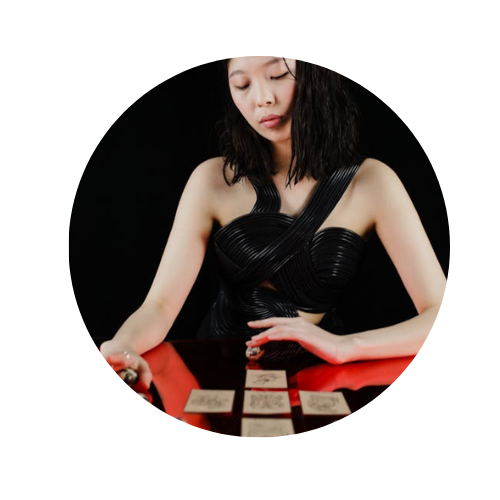
The Magician (01) of the Tarot
On the stage of Tarot, The Magician arrives when a person realizes they are no longer merely responding to events—they are shaping them. In a reading, his or her appearance signals a moment of conscious creation. A skill is ready to be used. A vision is ready to be spoken aloud. Resources—inner and outer—are already present, even if the querent hasn’t fully acknowledged them yet. The wand, the cup, the sword, and the pentacle sit before him like tools awaiting command. Nothing is missing.
Theatrically, The Magician is the scene where the audience leans forward. This is the moment of clever dialogue, decisive movement, and purposeful design. In life, this card often indicates a time when communication matters deeply: contracts, conversations, presentations, declarations of intent. It can show up when someone is launching a business, beginning a creative project, or finally saying the thing that changes everything. The Magician reminds us that words are not harmless—they are spells.
Yet there is a tension in this role. The Magician is a performer, and performance can slip into manipulation. In readings, their presence asks an important question: are you using your power consciously—or unconsciously? At its best, The Magician is aligned, ethical, and precise. At his worst, they are a trickster, a con artist, or a master of self-deception. When reversed or poorly supported, they can indicate misused talent, hollow confidence, or illusion masquerading as truth.



Still, this character is essential to the play. Without The Magician, nothing moves from inspiration into form. They are the bridge between The Fool’s leap and the unfolding journey ahead. In a person’s life, The Magician often appears when it’s time to stop waiting for permission. The tools are on the table. The knowledge has been acquired. The only remaining question is whether the querent will step into authorship of their own story.
As the scene closes, The Magician holds the audience’s gaze. She does not bow yet—there is too much still to do. She invites the viewer to recognize their own hands, their own voice, their own will. The magic, she insists, is not in the props or the performance. It is in the choice to act with intention. And once that choice is made, the play can never return to mere possibility.
Dive into your daily magic or journaling - without having to look anything up!
Discover the energies of each day of October 2026 including numerology, associated chakras, Sun, Moon and other astrological energies, recommended crystals, and a Tarot prompt for each day. This is the perfect companion piece for anyone who journals either for magic or for meditation. Only available until October 22, 2026 when the November Grimoire Companion launches.