
Neptune in Leo: The Dream Learned To Perform
Leo wants an audience. It wants the spotlight, the gasp, the standing ovation. Neptune is exalted here — technically its most powerful placement in the entire zodiac — and what that combination produced was a fourteen-year season where illusion stopped being a private mystical experience and became the biggest entertainment industry the world had ever built.
Neptune first touched Leo in September 1914, retreated back into Cancer that December, returned briefly the following July, slipped back again in March 1916, and finally settled into Leo for good on May 2, 1916 — holding through July 24, 1929. Thirteen years of Neptune doing exactly what it does best in the sign that rewards it most: making the unreal feel not just believable, but worth paying admission for.
The Golden Age Of Magic
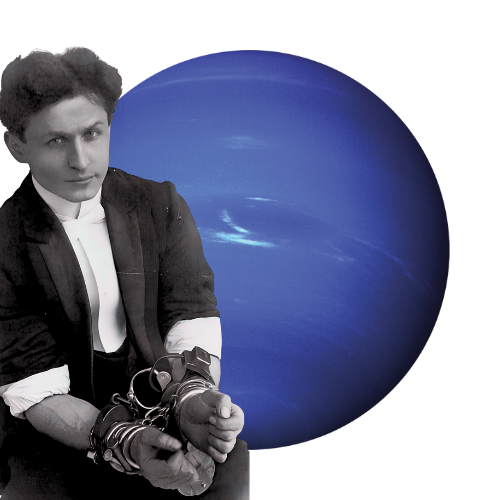
Vaudeville stages across America and Europe were packed with illusionists during this era — Howard Thurston, Harry Blackstone Sr., a whole circuit of performers turning sleight of hand into spectacle. But one name towered over all of them. Harry Houdini built an entire career on a very Leo-Neptune proposition: strap me into chains, lock me in a sealed box, drop me into a river, and watch me escape the impossible in front of your eyes. It wasn't just illusion. It was illusion staged as triumph, danger transformed into applause, and audiences worldwide couldn't get enough of watching a man appear to defeat death itself, night after night, on a stage built for exactly that purpose.
Neptune in Leo: Ego and Exposure
The Avatar Turns Detective
Here's where Houdini becomes the perfect avatar for this particular season, rather than just a great magician who happened to work during it. In the years after World War I, with an entire generation grieving sons and husbands lost overseas, spiritualist mediums did enormous business claiming to channel messages from the dead. Houdini, who understood the mechanics of illusion better than almost anyone alive, turned his skill into a crusade against them — attending séances in disguise, exposing trick after trick used by mediums like Mina "Margery" Crandon, and testifying before Congress about the psychological damage fraudulent spiritualism inflicted on grieving families. The man who built his fame on illusion spent his final years fighting other people's illusions when they were dishonestly sold as literal truth. That tension is the whole season in a single career: Neptune in Leo loved a performed illusion, applauded on a stage where everyone understood the rules. It had far less patience for the same trick played on someone in mourning who didn't know it was a trick at all.

Hollywood Learns To Manufacture Belief
While Houdini worked the stage, an entirely new industry was learning to do the same thing at a scale vaudeville never could. Theda Bara became the movies' first manufactured sex symbol, with her studio inventing a fictional biography for her out of whole cloth — exotic Arabian ancestry, a name reshuffled from an anagram of "Arab death," a persona built entirely to feed the public's appetite for something more thrilling than the truth. She was, in reality, Theodosia Goodman from Cincinnati, Ohio. The illusion wasn't incidental to her fame. It was the entire product.
Rudolph Valentino took that same machinery and proved just how real a manufactured fantasy could feel to the people consuming it. As the star of The Sheik, he became the era's defining romantic icon, and when he died suddenly in 1926 at thirty-one, the public grief was staggering — riots at his funeral, reports of fans taking their own lives, a collective mourning disproportionate to any relationship the mourners had actually had with the man rather than the character. Then, in 1927, Al Jolson starred in The Jazz Singer, the first feature film with synchronized dialogue and song, and the arrival of sound made illusion feel more real than it ever had before. It's worth naming honestly that the film includes Jolson performing in blackface, a practice common and unquestioned in mainstream entertainment at the time and rightly recognized now as a harmful legacy of that era's popular culture, not a footnote to set aside.
Ego, Undissolved: What Leo Actually Asks Of You
- Healthy Leo ego knows its own worth without needing an audience to confirm it first. Neptune-warped ego performs worth for a crowd because it doesn't trust the worth is real without one.
- Healthy Leo ego shares the stage generously, genuinely delighted by someone else's shine. Neptune-warped ego experiences someone else's spotlight as a personal eclipse.
- Healthy Leo ego tells the truth about itself, flaws included, because it isn't afraid of being seen clearly. Neptune-warped ego would rather be adored for a fiction than known for the truth.
- Healthy Leo ego creates because creation is its own reward. Neptune-warped ego creates as a transaction, constantly checking whether the applause has arrived yet.
- Healthy Leo ego can walk offstage and still know exactly who it is. Neptune-warped ego isn't sure it exists at all once the lights go down.
The Dream Before This One
Before the world learned to build its myths on a movie screen, it was still trying to reach them through a séance table. Next in this series: Neptune in Cancer, the fourteen years of the Spiritualist movement's height, ancestral longing, and a mysticism built entirely around home, family, and the wish to speak to the dead.