
Metatron's Cube: The Blueprint Inside Everything
There is an archangel in Jewish mystical tradition whose job, essentially, is to be the universe's record keeper.
Metatron — whose name appears in the Talmud and figures prominently in Kabbalistic texts — is described as the scribe of heaven, the angel who sits closest to the divine throne, the keeper of the Akashic Record (the cosmic ledger of every soul's experience across every lifetime). He is, depending on the tradition, either one of the most powerful angelic beings in existence or a human — the biblical Enoch — who was so devoted to understanding the nature of reality that he was transformed.
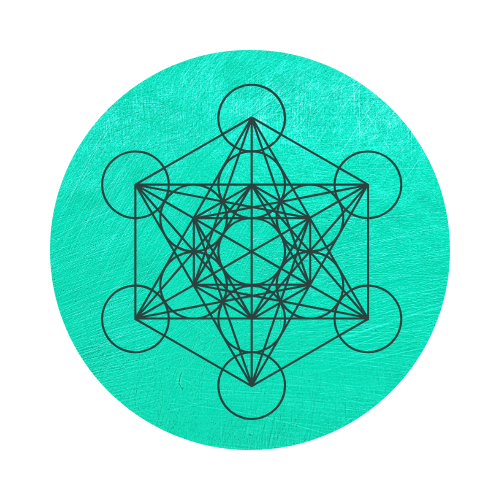
What's interesting for our purposes is not the theology but the geometry. Because Metatron's Cube — the sacred form associated with this archangel — is not symbolic in the decorative sense. It is a diagram. A technical drawing. A blueprint.
And what it's a blueprint for is the structure of physical matter itself.
How It's Built
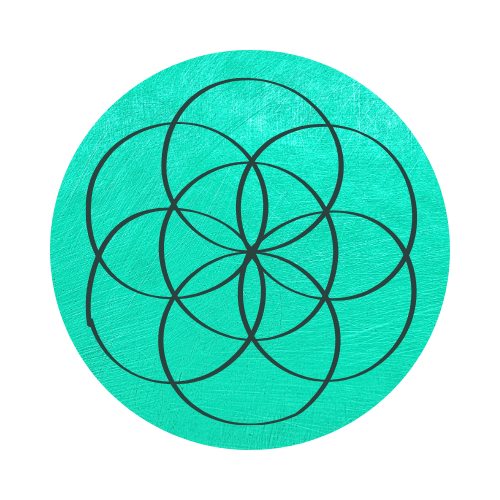
If you remember from our last post, the Flower of Life contains within it a hidden pattern called the Fruit of Life: thirteen circles arranged in a specific configuration that doesn't immediately look like anything in particular. Just thirteen circles.
Now connect the center of every circle to the center of every other circle with a straight line. Don't skip any. Connect all of them.
What emerges from those connecting lines is Metatron's Cube — a figure of extraordinary complexity and precision, made of 78 lines that seem, at first glance, almost impossibly intricate. It looks like something between a star, a mandala, and an engineering schematic. Which is, in a sense, exactly what it is.
Because hidden inside those 78 lines — if you know where to look — are all five of the Platonic Solids, nested one inside the other. And the Platonic Solids are where this gets genuinely fascinating.
The Five Shapes That Build Everything
Around 360 BCE, the Greek philosopher Plato proposed something radical: that all physical matter — everything that exists in the material world — is composed of five and only five fundamental geometric forms. He called them the elements, and he assigned each one to a building block of reality.
Modern physics has, in some ways, moved past this framework. In other ways, it has arrived at strikingly similar conclusions through an entirely different route. But for now, meet the five:
The Tetrahedron — four triangular faces, the simplest of the five solids. Plato associated it with fire: fast-moving, sharp, transformative energy. In the energy body, it corresponds to the solar plexus — the seat of will, personal power, and digestion of experience.
The Cube (also called the Hexahedron) — six square faces, the most stable of the five. Associated with earth: grounded, structured, physical. It corresponds to the root chakra, the foundation, the body's relationship to material reality.
The Octahedron — eight triangular faces, symmetrical in all directions. Associated with air: the realm of mind, communication, and relationship. It corresponds to the heart chakra — the mediating point between the lower three chakras and the upper three, the bridge between earth and sky.
The Icosahedron — twenty triangular faces, the most sphere-like of the five solids. Associated with water: flow, emotion, intuition, the unconscious. It corresponds to the sacral chakra, the center of creativity, feeling, and connection.
The Dodecahedron — twelve pentagonal faces, the most complex of the five. Plato associated this one with the cosmos itself — the shape of the universe. It corresponds to the upper chakras: the throat, third eye, and crown, the realm of higher consciousness, cosmic awareness, and the capacity to perceive beyond the physical.
All five of these forms share something remarkable: every edge is exactly the same length as every other edge. Every face is identical to every other face. They are perfectly, completely symmetrical in three dimensions. In the entire universe of possible geometric shapes, only five forms have this quality. Five. No more exist.
And all five are hidden inside Metatron's Cube.


What This Has To Do With Your Energy Field
Here is where the ancient and the practical meet.
Many healing traditions — Reiki among them — work with the understanding that the human energy field is not just one thing. It's layered. The physical body is the densest layer, but around and interpenetrating it are subtler fields: the etheric body (the energetic blueprint of the physical), the emotional body, the mental body, the astral body, and beyond those, even finer layers connected to higher states of consciousness.
Each of the Platonic Solids, according to various esoteric traditions, corresponds to one of these layers. The cube anchors the physical and etheric. The icosahedron holds the emotional. The octahedron mediates the mental field. The tetrahedron relates to the astral and causal layers. The dodecahedron corresponds to the outermost fields, the ones most directly connected to what might be called the soul or the higher self.
What Metatron's Cube offers, then, is a map — not of the body, but of the total energetic architecture of a human being. Every layer, every dimension of your field, accounted for in a single geometric figure.
This is why the form shows up so often in energy healing contexts. It isn't decoration. It's a schematic.
The Archangel As An Idea
Whether or not you work with angels, Metatron as an archetype is worth sitting with for a moment.
He is the being who stands at the intersection of the human and the divine — the scribe, the witness, the one who holds the record of everything that has ever happened and everything that could happen. His geometry contains all possible forms of matter. His role is to translate the infinite into the finite, the formless into the formed.
In that sense, Metatron's Cube isn't just a picture of physical reality. It's a picture of the act of creation — the moment when pure energy organizes itself into matter. The moment when a possibility becomes a thing.
For those who work with intention, manifestation, or prayer in any form, this is the geometry of that process. The movement from the unformed to the formed. From the Flower of Life — pure potential, endlessly repeating circles — to the Cube — specific, structured, actual.
You could think of Metatron as the intelligence that manages that transition. The one who holds the blueprint.

Working With Metatron's Cube
A few ways to bring this form into your practice, regardless of where you are on the spiritual spectrum:
For Reiki practitioners: Try visualizing Metatron's Cube at the beginning of a session — either around the client or between your hands and theirs. The intention is not to impose a structure but to call in coherence. You're essentially asking the session to organize itself at the highest level of the recipient's field.
For anyone working with intention: Write what you want to bring into form in the center of an image of Metatron's Cube. This is a simple practice, but it's not arbitrary — you're placing your intention inside the geometric structure that represents the transition from potential to physical reality.
For meditation: Metatron's Cube is complex enough that your eyes can wander through it for a long time without getting bored. Try this: start at the center and let your gaze move outward slowly along the lines. Notice when you start to see the individual Platonic Solids emerge from the pattern. There's a small but real shift in perception that happens when a hidden structure suddenly becomes visible, and that shift is itself a kind of practice — training the mind to see what's present but not immediately obvious.
As a protective form: Many practitioners use Metatron's Cube as an energetic seal — visualizing it around a space, a person, or a situation that needs both protection and clarification. The logic is that a space held in perfect geometric coherence has less room for chaos or interference.
A Note On Complexity
Metatron's Cube can feel overwhelming at first glance. That's normal. It is genuinely complex. But complexity isn't the point — completeness is. This is a form that contains everything. You don't have to understand all of it to work with any part of it.
Start with one of the Platonic Solids. The cube, maybe — simple, stable, grounding. Or the icosahedron if you're doing emotional work. Let the piece that resonates be your entry point, and trust that the rest of the map is there when you need it.
The blueprint doesn't require you to build the whole building at once.
Dive into your daily magic or journaling - without having to look anything up!
Discover the energies of each day of October 2026 including numerology, associated chakras, Sun, Moon and other astrological energies, recommended crystals, and a Tarot prompt for each day. This is the perfect companion piece for anyone who journals either for magic or for meditation. Only available until October 22, 2026 when the November Grimoire Companion launches.