
The Flower Of Life: The Pattern That Keeps Showing Up Everywhere
In the Temple of Osiris at Abydos, Egypt — one of the oldest temples in the world — there is a pattern carved into the granite that has puzzled researchers for decades. Not because it's difficult to understand. Because of how it got there.
The pattern is burned into the stone, not carved. The lines are too precise, the geometry too perfect, to have been made by the tools available at the time. No one knows exactly how it was created. What researchers do know is that it is at least 6,000 years old — and that the exact same pattern appears in temples across China, in ancient synagogues in Israel and Tunisia, in a 2,000-year-old mosaic in Pompeii, in Leonardo da Vinci's notebooks, in medieval European cathedrals, and in temples across India and Japan.
The same pattern. Across cultures that had no contact with each other. Across thousands of years.
It's called the Flower of Life. And once you know what it looks like, you will start seeing it absolutely everywhere.
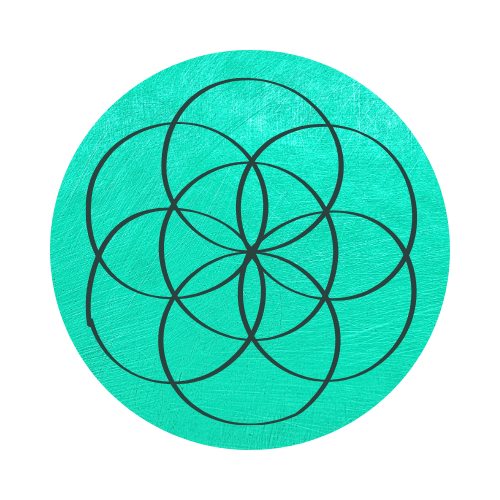
What It Actually Is
The Flower of Life begins with a single circle. Then another circle is drawn with its center on the edge of the first. Then another, and another, each new circle centered on an existing intersection point. After the first ring of six circles is complete, the pattern begins to look like a flower — six petals around a central circle, all perfectly interlocking. Keep going, and the flower grows outward in every direction, each new ring of circles fitting perfectly against the last.
The result looks organic, almost alive. Which is exactly the point.
What the builders of those ancient temples understood — and what mathematicians have confirmed — is that this pattern is not just beautiful. It is structurally fundamental. The Flower of Life contains within it, hidden in its intersecting lines, virtually every other sacred geometric form: the Vesica Piscis we explored in the last post, the Seed of Life, the Egg of Life, the Fruit of Life, the Tree of Life from Kabbalah, and — if you know how to look — Metatron's Cube, which we'll unpack in the next post.
It is, in a very real sense, a diagram of how form emerges from nothing. A visual map of creation.
The World Tour
What makes the Flower of Life genuinely extraordinary isn't the geometry itself — it's the fact that human beings kept arriving at it independently, across time and geography, and kept treating it as sacred. Let's take a quick tour.
Egypt. The Abydos temple rendering is the oldest known physical example, but the proportions encoded in the Great Pyramid at Giza are consistent with Flower of Life geometry. Some researchers believe the entire pyramid complex was designed according to this pattern, though that remains debated.
China. The pattern appears in the Forbidden City in Beijing — carved into the spheres held under the paws of the imperial guardian lions. It is also embedded in ancient Chinese bronze mirror designs, where it was associated with protection and cosmic order.
Israel and the Jewish tradition. The Flower of Life appears in ancient synagogues at Capernaum and Masada. More significantly, the Kabbalistic Tree of Life — the diagram of ten spheres connected by 22 paths that maps the structure of divine consciousness — can be derived directly from the Flower of Life by connecting specific intersection points. The two systems are, geometrically, the same system.
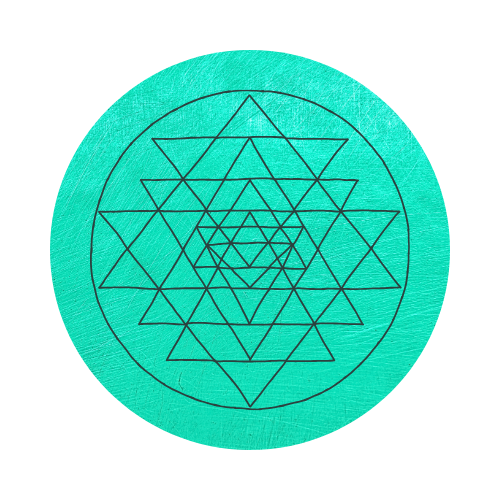
India. The pattern appears in temples dedicated to Vishnu and is associated in Vedic tradition with the concept of Indra's Net — an infinite web of jewels, each one reflecting every other, used as a metaphor for the interconnected nature of all existence. It is, again, the same idea in a different language.
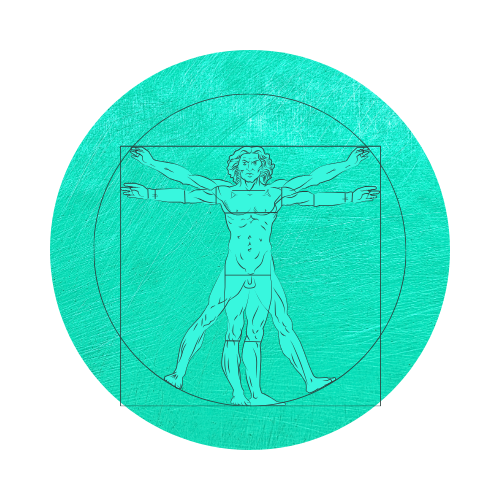
The Renaissance. Leonardo da Vinci studied the Flower of Life extensively and drew it in his notebooks alongside studies of its mathematical properties. He was particularly interested in how the golden ratio — the proportion he used in his paintings — was embedded in the geometry.
Different civilizations. Different centuries. Different spiritual frameworks. The same picture.


Why Does This Keep Happening?
There are a few ways to think about why the Flower of Life kept emerging independently across human cultures.
The first is purely mathematical: the pattern is generated by one of the simplest geometric operations possible — drawing equal circles whose centers lie on each other's circumferences — and once you start, the pattern is self-completing. It almost draws itself. Any civilization that worked seriously with geometry would eventually encounter it.
The second is more interesting: perhaps the pattern kept being recognized, rather than invented, because it reflects something real about the structure of the natural world. We've already established that nature organizes itself according to mathematical principles. The Flower of Life may be the most comprehensive visual summary of those principles — which is why every culture that looked carefully at the world around them eventually arrived at the same diagram.
The third possibility — and this is where the sacred part of sacred geometry lives — is that the pattern carries information. Not symbolically, but structurally. That working with it, meditating on it, building according to its proportions, does something to the human mind and energy field that these ancient builders understood and we are only beginning to quantify.
All three of these explanations can be true at the same time.
The Seed Hidden Inside The Flower
Before the full Flower of Life is complete, there is an earlier stage: seven circles, the central one surrounded by six, that form what's called the Seed of Life. This smaller pattern is the embryonic version of the larger one — and it maps, with uncanny precision, to the seven days of creation described in Genesis.
Day one: the first circle, light divided from darkness. Day two: the second circle, the firmament. Day three through seven: each subsequent circle corresponding to each subsequent act of creation, until on the seventh "day" — the seventh circle — the pattern is complete and rests.
Whether you read Genesis literally or metaphorically, the correspondence is striking. The Seed of Life isn't illustrating the creation story. According to the Hermetic tradition, the creation story is describing the geometry. The universe didn't just result in these patterns. It was built by them.
Working With This Pattern
You don't need to understand the mathematics to work with the Flower of Life. Here are three simple ways to bring it into your practice:
As a meditation focus. Find an image of the Flower of Life — there are many beautiful versions available — and use it as a gazing object during meditation. Let your eyes soften and move naturally through the pattern without trying to follow any particular line. Notice what happens to your mind. Most people report a fairly rapid sense of quiet.
As a protective symbol. Many energy workers and intuitive practitioners use the Flower of Life as an energetic container — imagining it around a space, a person, or a situation as a way of bringing order and coherence to scattered or chaotic energy. Think of it as a geometric version of casting a circle.
As a journaling prompt. The central question of the Flower of Life is interconnection: everything contained within the larger pattern was generated by the same simple act, repeated. Ask yourself where in your life you're failing to see the connections between things that seem separate. What's the single repeating action — positive or negative — that's generating the larger pattern of your experience right now?
Before The Next Post
The Flower of Life, as we've discussed, contains within it a form called the Fruit of Life — thirteen circles connected in a specific way that generates one of the most complex and significant geometric structures in the entire tradition.
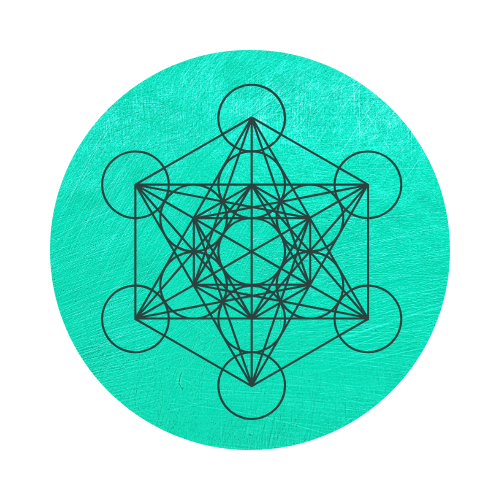
Connect those thirteen circles with straight lines, and you get Metatron's Cube: the archangel's map of reality, and the structure that contains every Platonic Solid — the five geometric forms that ancient philosophy believed were the literal building blocks of all physical matter.
That's where we're headed next.
Dive into your daily magic or journaling - without having to look anything up!
Discover the energies of each day of October 2026 including numerology, associated chakras, Sun, Moon and other astrological energies, recommended crystals, and a Tarot prompt for each day. This is the perfect companion piece for anyone who journals either for magic or for meditation. Only available until October 22, 2026 when the November Grimoire Companion launches.