
Neptune in Libra: The Dream Of A Restored Balance
Libra wants harmony. It wants the scales level, the conflict resolved, the story to end with everyone shaking hands. After a war that had just ended with two atomic bombs and tens of millions dead, that's exactly the dream the world reached for — not because balance had actually been restored, but because everyone involved needed, desperately, to believe it had.
Neptune first touched Libra in October 1942, retreated back into Virgo that April, and settled into Libra for good on August 2, 1943 — holding through October 19, 1956, with one last dip into Scorpio at the very end of 1955 before crossing over for keeps. Thirteen years of Neptune's fog meeting Libra's hunger for symmetry, and the culture it produced spent the whole era insisting the world had been set right again. It hadn't, not fully — but the insistence itself is the story worth telling.
Peace By Committee
The scaffolding for a rebalanced world went up almost immediately. The United Nations was founded in 1945, built on the explicit promise of collective security and a war-to-end-all-wars finality that the League of Nations had failed to deliver a generation earlier. The Nuremberg trials pursued something the world had never fully attempted before: formal, public justice for atrocity, war crimes named and prosecuted rather than simply absorbed into the peace. It was real. It also wasn't the whole picture — the same UN charged with keeping peace was almost immediately paralyzed by Cold War vetoes, and plenty of individuals with real wartime guilt, including scientists absorbed into new national programs, quietly avoided the reckoning altogether. Libra wanted the ledger balanced. Neptune made sure the ledger looked balanced whether or not it fully was.

Roswell, Eisenhower, And The Enemy Within
Underneath the diplomacy, the anxiety never actually resolved — it just changed shape. Roswell, in the summer of 1947, gave a shaken postwar public an entirely new kind of unresolved mystery to hold, one about a strange craft and stranger cover stories, arriving right as fear of the unknown found a fresh place to live besides the war just ended. Eisenhower took office in 1953, ending the Korean War with an armistice rather than a resolution — another balance struck more on paper than in fact — and delivered his "Atoms for Peace" speech that same year, reframing the very weapon that had ended the last war as a tool for harmony and progress. He wouldn't coin the phrase "military-industrial complex" until his farewell address in 1961, just past this season's edge, but the arms race quietly accelerating underneath his presidency's language of peace is exactly what that later warning was describing. Even celebrity culture staged its own version of diplomatic balance that decade — Grace Kelly's 1956 marriage to Prince Rainier of Monaco was reported as a fairy tale, but underneath the gown it was a genuinely strategic alliance between American glamour and old-world power, a power broker's arrangement dressed up as romance.
Neptune in Libra: Fairness? Or a witchhunt?
The Avatar Of The Era
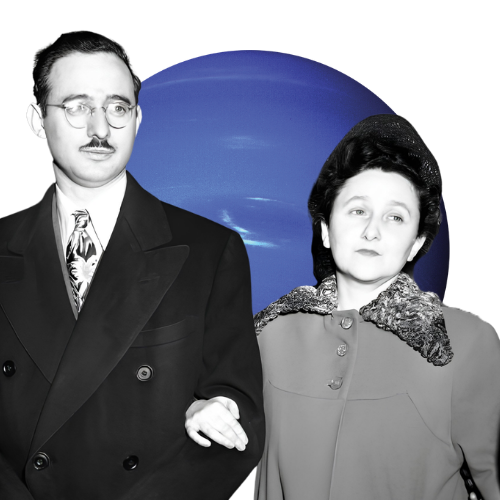
Julius and Ethel Rosenberg are the sharpest fit this season has to offer, precisely because Libra rules the scales of justice itself, and their case is the moment this era's justice system was put on trial along with them. Convicted of espionage and executed in 1953, the Rosenbergs became the literal embodiment of the decade's central anxiety: the enemy wasn't overseas anymore, it might be your neighbor, your coworker, someone who looked exactly like everyone else. Their trial was presented as balance delivered — due process, a jury, a verdict — and it has remained contested and re-litigated in the public record ever since, with real questions about the fairness of the proceedings and the full truth of what each of them actually did. That's the whole season in one case file: a system insisting the scales were level, while an uncomfortable number of people, then and now, were never quite sure they were.
The Visionaries Of The Era
- Walt Disney — opened Disneyland in July 1955, an entire manufactured utopia sold as harmony achieved rather than harmony performed.
- Wernher von Braun — a former Nazi rocket scientist absorbed into the American space program, who became the friendly public face of the space dream through Disney's own "Man in Space" television specials, one of the era's strangest true reinventions.
- Buckminster Fuller — designed the geodesic dome and preached a philosophy of doing more with less, offering an actual blueprint for a more balanced, efficient world rather than just the image of one.
- Jonas Salk — developed the polio vaccine, announced in 1955, one of this season's rare pieces of restored balance that was completely, unambiguously real.
- Alfred Hitchcock — working the other side of the same coin throughout this exact season, building elegant, controlled surfaces in Rear Window and The Man Who Knew Too Much with something dangerous always coiled just beneath them.
The Dream Before This One
Before the world tried to convince itself it had found balance, it was still counting the cost. Next in this series: Neptune in Virgo, the fourteen years of the Great Depression, the Dust Bowl, and a mysticism built almost entirely out of scarcity, service, and sacrifice.