
The Universe Writes In Shapes
Look at your hand for a moment. Really look at it.
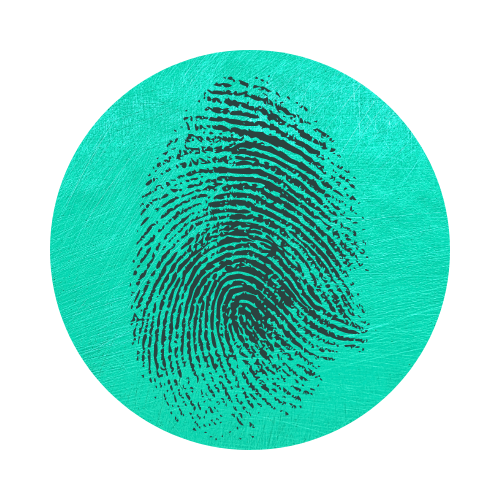
The way your fingers taper. The branching lines of your palm. The spiral at the tip of each fingerprint — unique to you, yet following the same curling pattern found in the center of a sunflower, in the arms of a galaxy, in the shell of a nautilus that has never seen a human hand and never will.
That's not a coincidence. That's a language.
Sacred geometry is the study of that language. It's the idea — ancient, cross-cultural, and increasingly supported by science — that the universe organizes itself according to a set of recurring shapes and proportional relationships. That these patterns aren't random. That they mean something.
And here's what I find most exciting about that: you don't need to be a mathematician, a mystic, or even particularly spiritual to start noticing them. You just need to start looking.
It Starts With A Seed
Every flowering plant begins its life with a single cell that divides. That cell becomes two, two becomes four, and so on. But the plant doesn't just grow randomly outward in all directions. It organizes. The placement of each new leaf, each petal, each seed in the flower head follows a precise angular pattern — roughly 137.5 degrees from the last — that prevents any two leaves from blocking each other's light and allows the maximum number of seeds to pack into the smallest possible space.
That angle, 137.5 degrees, is derived from the golden ratio: the mathematical proportion 1 to 1.618 that appears throughout nature with such consistency that the ancient Greeks called it the divine proportion. It shows up in the spiral of a pinecone, the branching of a river delta, the curve of a breaking wave, the proportions of the human face.
The plant doesn't know it's doing this. It doesn't calculate. It simply grows according to the pattern encoded into its nature.
Which raises a question worth sitting with: what is that pattern encoded into?
Why "Sacred"?
The word tends to put people off a little — it sounds either too religious or too woo. But the original meaning is simpler than either. Sacred just means set apart. Deserving of attention. Worth more than a passing glance.
Across vastly different cultures and time periods, builders, philosophers, artists, and spiritual teachers noticed the same geometric patterns appearing everywhere they looked — in the structure of crystals, in the proportions of the human body, in the movements of the planets — and concluded that these forms were the universe's way of showing us how it works. How it thinks, if you want to go there.
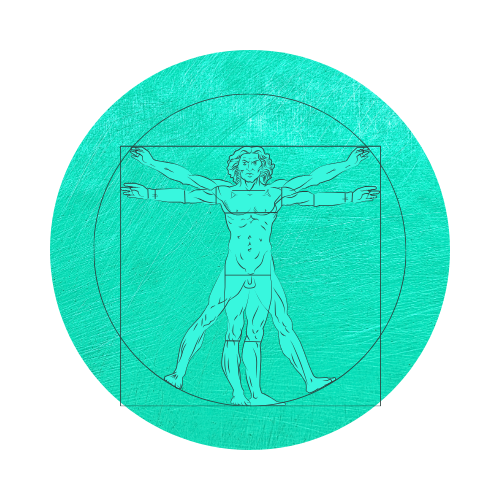
The ancient Egyptians encoded these proportions into the pyramids. Greek philosophers — Pythagoras, Plato — built entire philosophical systems around geometric form, believing that shapes like the sphere, the tetrahedron, and the cube were the literal building blocks of matter. Islamic artists, forbidden from depicting the human form, turned instead to geometric tiling and found that they could represent the infinite nature of the divine through repeating patterns that never quite resolve, never quite repeat. Medieval cathedral builders used specific proportions to create spaces that did something measurable to the nervous system of anyone who entered — a sense of expansion, peace, awe.
They were all, in their different ways, working with the same underlying grammar.


The "As Above, So Below" Principle
There's a phrase that comes up in Hermeticism, the philosophical tradition that deeply influenced Western astrology and alchemy: as above, so below. As within, so without.
It's basically saying: the same patterns show up at every scale of reality. The spiral of a galaxy and the spiral of a fingerprint operate on the same geometric logic. The structure of a snowflake and the structure of a certain kind of crystal are governed by the same mathematical relationships. The branching pattern of your lungs and the branching pattern of a river and the branching pattern of a bolt of lightning are, geometrically speaking, the same thing.
This isn't mysticism for its own sake. Fractals — a modern mathematical concept — describe exactly this: self-similar patterns that repeat at every scale. The natural world is full of them. Your body is full of them.
For those of us drawn to astrology, this principle is essentially the philosophical foundation of the whole practice. If the patterns of the cosmos and the patterns of human experience are connected — if the macro and the micro echo each other — then of course the movements of the planets would be meaningful in the context of a human life. Of course the same geometry that organises the solar system would organise the cells of your body.
The universe writes in shapes. We are written in the same language.
What This Series Is Going To Explore
Over the next five blogs in this series, we're going to look at specific sacred geometric forms — not just as abstract concepts, but as living symbols with real applications in spirituality, energy work, and the way we understand ourselves.
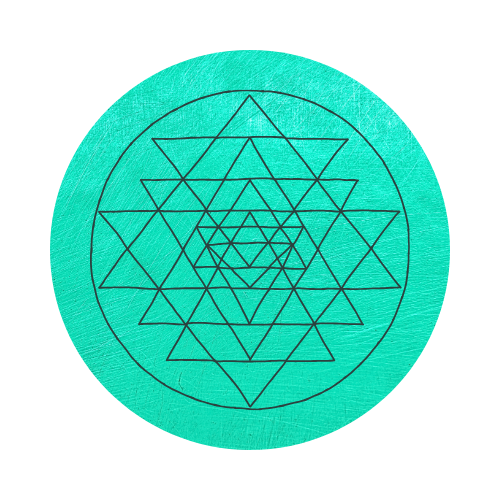
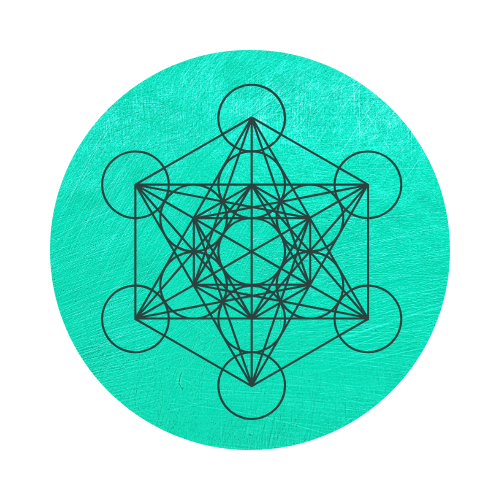
We'll start with what might be the most generative shape in existence: two overlapping circles and the space they create between them. We'll move through the Flower of Life — a pattern so old it was carved into stone before recorded history — and into Metatron's Cube, which contains within it the five geometric forms that ancient philosophy believed made up all of physical matter. We'll look at the Sri Yantra, a diagram so complex that scholars believe it cannot be constructed by hand without error, and what it means to use geometry as a meditative practice rather than just an intellectual exercise. And we'll end where things get personal: the geometry encoded in your own body, your own energy field, and — for those of you who work with it — your own birth chart.
Each of these forms has something to teach. Not in an abstract, you-have-to-take-it-on-faith way, but in the very literal sense that when you look at them — really look — something in you recognises them. That recognition is worth exploring.
A Simple Exercise Before We Go Further
Go outside, or even just to a window. Pick one natural thing — a plant, a cloud, a tree, the pattern of light on water — and look at it for longer than you normally would. Not analytically. Just openly.
Notice if any part of it repeats. Notice if there's a pattern that seems to spiral, or branch, or radiate outward from a centre. Notice what it feels like to see that.
You don't have to name it or understand it. Just notice.
That noticing — that small act of paying attention to the structure of the world — is, I'd argue, where all of this really begins. Not in the reading, not in the theory. In the looking.
Next in this series: The Vesica Piscis — the womb of all form. Two circles, one ancient mystery, and why this shape has been quietly hiding in plain sight across every spiritual tradition you can name.
Dive into your daily magic or journaling - without having to look anything up!
Discover the energies of each day of October 2026 including numerology, associated chakras, Sun, Moon and other astrological energies, recommended crystals, and a Tarot prompt for each day. This is the perfect companion piece for anyone who journals either for magic or for meditation. Only available until October 22, 2026 when the November Grimoire Companion launches.