
The Sri Yantra And The Golden Spiral: Geometry You Can Actually Enter
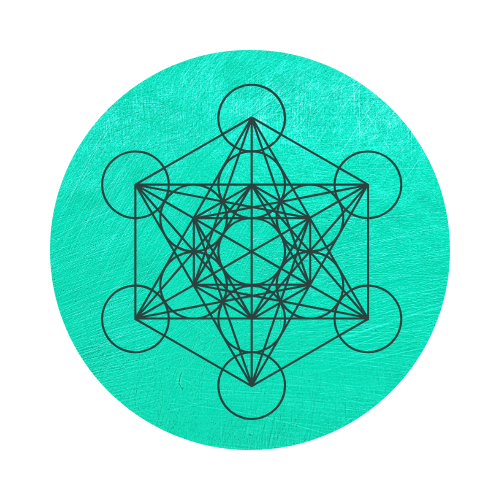
Most of the forms we've looked at in this series are things you observe. You look at the Flower of Life. You study Metatron's Cube. You trace the Vesica Piscis with your eyes and let the symbolism settle.
The Sri Yantra is different.
It isn't designed to be looked at the way you look at a painting. It's designed to be entered — the way you enter a meditation, or a piece of music that gradually takes over the room until you forget there's anything outside of it. Ancient texts describe the Sri Yantra not as a symbol of the divine but as a living map of consciousness itself. Meditating on it, according to these traditions, doesn't teach you something about reality. It moves you through it.
That's a significant claim. But spend some time with this particular piece of geometry and you start to understand why people have been making it for thousands of years.
Nine Triangles. One Impossible Task.
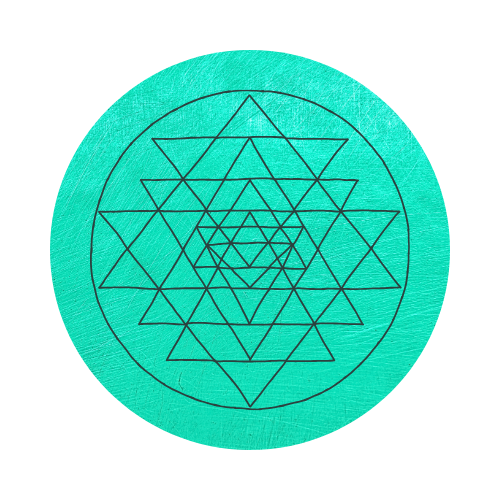
The Sri Yantra is composed of nine interlocking triangles arranged around a central point called the bindu — a Sanskrit word meaning "drop" or "point," representing the place before creation, the moment of pure potential before anything takes form.
Four of the triangles point upward, representing Shiva — the masculine principle, pure consciousness, stillness. Five point downward, representing Shakti — the feminine principle, dynamic energy, movement and form. Together they create 43 smaller triangles, enclosed in a series of lotus rings and a square outer boundary with four gates, representing the four directions and the four elements.
It sounds straightforward until you try to draw it.
The Sri Yantra cannot be constructed accurately by hand. This is not an exaggeration or a mystical claim — it is a geometric fact. The nine triangles must intersect at precisely the right points, and achieving this without error requires mathematical precision that was not available through manual drafting tools until the advent of computer-aided design. Yet Sri Yantras have been found carved in stone and cast in metal across India dating back thousands of years, constructed with an accuracy that continues to puzzle researchers.
How they were made is, like the Abydos Flower of Life, genuinely unknown.
What It's Actually A Map Of
The 43 triangles of the Sri Yantra are not decorative subdivisions. Each corresponds to a specific aspect of consciousness, a specific energy center, or a specific quality of experience. The entire diagram — from the outer square to the central bindu — represents the journey of awareness from the outermost, most diffuse level of experience inward to the most concentrated point of pure being.
Moving from the outside in:
The outer square represents the material world — ordinary waking consciousness, the physical dimension, the world we navigate every day.
The lotus petals represent the transition zones — the places where one state of being gives way to another. The 16-petal outer lotus corresponds to the full spectrum of human desire and fulfillment. The 8-petal inner lotus corresponds to the eight directions of the subtle body.
The interlocking triangles are the heart of the diagram — the field of dynamic tension between consciousness and energy, stillness and movement, the masculine and feminine principles in constant creative relationship.
The central triangle is the threshold — the last distinction before pure awareness, the final form before formlessness.
The bindu at the center is the destination. Not a place you arrive at from outside, but a point you uncover within yourself. The Sri Yantra isn't a map of somewhere else. It's a map of you.


The Golden Spiral: Nature's Signature
Running through the Sri Yantra, through the Flower of Life, through virtually every sacred geometric form we've discussed in this series, is a mathematical relationship so consistent across nature that it functions almost like a signature.
The golden ratio — approximately 1 to 1.618, often represented by the Greek letter phi — is the proportion that appears when you divide a line so that the ratio of the whole line to the longer segment equals the ratio of the longer segment to the shorter one. It sounds like an abstraction. Its appearances in the natural world are anything but.
When the golden ratio is expressed as a spiral — each quarter-turn expanding by a factor of phi — the result is called the golden spiral. And this is the spiral of the nautilus shell, the spiral of the sunflower seed head, the spiral of a hurricane viewed from above, the spiral of the Milky Way galaxy, the spiral of the cochlea in your inner ear that allows you to hear.
It is also, not coincidentally, the spiral of growth itself. Every living system that grows outward from a center — every plant, every animal, every organism — does so in proportions that approximate the golden ratio. It is the mathematical signature of life adding to itself.
When A Number Becomes An Experience
Here is something worth slowing down for.
The golden ratio is irrational — meaning it cannot be expressed as a simple fraction, and its decimal expansion never ends and never repeats. 1.6180339887... and on, forever. It is infinite. It never resolves.
This turns out to be precisely why it works so well in living systems. A plant growing according to a ratio that never quite repeats will never place two leaves in exactly the same position, which means every leaf gets maximum exposure to light. A shell growing in golden spiral proportions can expand indefinitely without ever changing its shape. The proportion accommodates infinite growth while maintaining perfect coherence.
Ancient builders and philosophers saw in this something genuinely profound: a number that is both precise and infinite, both ordered and inexhaustible. A mathematical expression of the divine — something that follows perfect rules and yet never comes to an end.
This is why the golden ratio shows up in the Parthenon, in Gothic cathedrals, in Renaissance painting, in Islamic geometric art. Not because these builders were all following the same manual, but because they were all trying to build something that felt alive. And the golden ratio is, in the most literal sense, the geometry of life.
The Spiral In Your Own Chart
For those of you who work with astrology, here is something to consider.
Your natal chart is a circle divided into 360 degrees. The major aspect patterns — the trine, the square, the sextile, the opposition — divide that circle according to specific proportions. The trine divides it into thirds; the square into quarters; the sextile into sixths.
But the most personally significant point in most charts — the Ascendant, the exact degree rising on the eastern horizon at the moment of your birth — is unique to you, to that specific minute, at that specific location. It doesn't repeat. Not in your lifetime. Not in the lifetimes of most people alive today.
That single non-repeating point, placed within a circle divided by perfect geometric proportions, is in some ways a living expression of the golden ratio principle: a unique, unrepeating specificity, held within a perfectly ordered universal structure.
You are the irrational number inside the geometric form. The thing that never quite repeats, expanding outward through your life in a pattern that is both completely ordered and completely your own.
A Practice: Gazing With Intention
The traditional practice associated with the Sri Yantra is called trataka — a steady, soft-eyed gaze directed at the center of the diagram without blinking for as long as is comfortable.
You don't need to understand the symbolism. You don't need to be a Hindu practitioner or have any particular belief system. What the practice does, neurologically, is shift the brain away from active, analytical processing and into a quieter, more receptive mode. The complexity of the Sri Yantra gives the analytical mind just enough to engage with that it stays out of the way. The rest of you gets some space.
Here's a version accessible to anyone:
Find an image of the Sri Yantra — there are many beautiful ones available online, and printed versions are widely sold. Place it at eye level. Soft lighting works better than harsh overhead light. Sit comfortably, close your eyes, and take a few slow breaths. When you open your eyes, let your gaze land gently on the central point — the bindu — without forcing it.
Don't try to trace the triangles or analyze the structure. Just rest your gaze at the center and let the pattern exist in your peripheral vision.
Stay there for as long as feels natural. Two minutes. Five. Ten.
Notice what happens to your thoughts. Notice what happens to your sense of time. Notice — and this is the interesting part — whether anything shifts in how you feel about whatever you were thinking about before you sat down.
The Sri Yantra has been used as a meditation tool for thousands of years because it works. You don't have to take that on faith. You can just try it.
Before We Close The Series
We've traveled through a lot of geometry in these five posts — from the most basic act of drawing a circle, through the forms hidden inside the Flower of Life, through the blueprint of matter in Metatron's Cube, and now into a diagram of consciousness itself.
In the final post, we bring all of it home. Literally into your body, your energy field, and for those who work with it, your birth chart. Because everything we've discussed — every form, every proportion, every pattern — is already present in you.
You've been the sacred geometry all along.
Dive into your daily magic or journaling - without having to look anything up!
Discover the energies of each day of October 2026 including numerology, associated chakras, Sun, Moon and other astrological energies, recommended crystals, and a Tarot prompt for each day. This is the perfect companion piece for anyone who journals either for magic or for meditation. Only available until October 22, 2026 when the November Grimoire Companion launches.