
The Vesica Piscis: The Shape That Starts Everything
There is a shape so old, so quietly embedded in the history of human spirituality, that most of us have seen it hundreds of times without ever knowing what we were looking at.
You've seen it as the pointed oval halo surrounding Christ and the Virgin Mary in medieval paintings. You've seen it as the ichthys — the "Jesus fish" — on the back of cars. You've seen it in the eye of every deity ever carved into stone. You've seen it in the shape of a cathedral window, a mandorla in Buddhist art, the outline of a leaf, the pupil of a cat's eye.
It is made from two circles. That's all. Two circles, the same size, each passing through the center of the other. The shape they create where they overlap is called the Vesica Piscis — Latin for "vessel of the fish" — and it may be the most quietly significant form in all of sacred geometry.
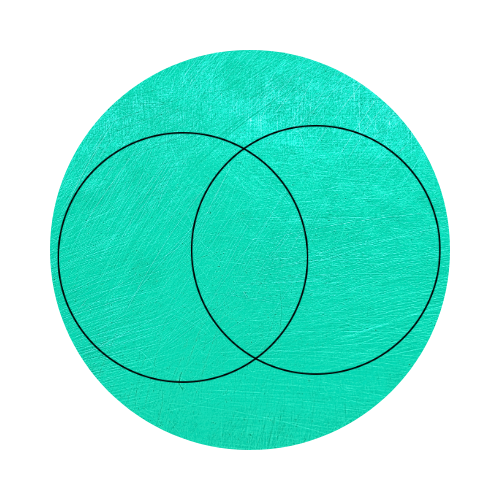
Vesica Piscis
Two Circles Walk Into A Temple
To make a Vesica Piscis, you don't need anything more than a compass and a piece of paper. Draw one circle. Then, keeping the same radius, place the point of your compass on the edge of that circle and draw another. The two circles will overlap, and in the center, you'll see a shape like an eye, or a leaf, or a doorway.
That doorway is not accidental.
The Vesica Piscis is one of the first shapes generated by the most basic geometric act — circle meets circle — and ancient builders recognized it as a kind of origin point. The earliest known geometric texts describe it as the matrix from which all other forms emerge. If you extend lines through specific points of the Vesica Piscis, you can generate equilateral triangles, squares, and the golden ratio. It is, in a very literal geometric sense, a womb.
This is why the early Church placed Christ within it. The mandorla — an Italian word meaning "almond," which is what the shape resembles — was used in Christian iconography to indicate someone who existed between two worlds, human and divine, earth and heaven. The shape itself communicated liminality. The threshold. The place where two realities meet.
The Number Two, And What It Actually Means
Most spiritual traditions have something to say about duality. Not duality as a problem to be solved, but as the fundamental nature of existence: light and dark, masculine and feminine, matter and spirit, the self and the other.
The Vesica Piscis is a geometric expression of what happens when two things — distinct, whole, each complete in themselves — choose to intersect. The two circles don't merge. They don't collapse into each other. They remain themselves, while creating something entirely new in the space between them.
That in-between space is where the magic lives. It's not one thing or the other. It's both, simultaneously.
For those who work with tarot, this might call to mind the High Priestess — the card of the threshold, the veil, the space between what is known and what is not yet revealed. She sits between two pillars. She holds the scroll of hidden knowledge. She is, in her essence, a keeper of the between. The Vesica Piscis is her geometry.
For those drawn to astrology, think of the opposition aspect — two planets at 180 degrees from each other, in dialogue across the full width of the chart. The tension of the opposition is real, but so is the invitation: to find the connecting thread, the place where two seemingly contrary things turn out to be two faces of the same truth. The Vesica Piscis is what that connecting thread looks like as a shape.

A Shape That Moves Energy
Here's where things get interesting for anyone who works with energy healing.
In Reiki and other hands-on healing modalities, practitioners often describe the experience of channeling energy as a sense of passing something through — not generating it themselves, but acting as a conduit. A vessel. The healing doesn't originate in the healer; it flows through the healer from a larger source.
The Vesica Piscis, geometrically, is exactly that: a channel. A passageway created by the intersection of two fields. Some energy workers use it intentionally — visualizing the overlapping circles as the practitioner's field and the recipient's field meeting, with the healing flowing through the lens of their intersection.
Whether or not you work with energy healing, this is a useful metaphor for any kind of genuine connection. When two people are really in conversation — not just talking at each other, but actually meeting — something gets created in the space between them that didn't exist before. Something that belongs to neither person alone.
The shape has a name for that something. It's the Vesica Piscis.
Where You've Already Seen It
Part of what makes sacred geometry so satisfying, once you start learning it, is the way it reorganizes your experience of things you've always known. The Vesica Piscis is everywhere once you can name it.
In nature: The cross-section of a cell at the moment it divides is a Vesica Piscis. Life itself begins in this shape, every single time.
In architecture: The pointed arch — the defining feature of Gothic cathedrals — is derived from two overlapping circles. The builders knew what they were doing. They were constructing spaces shaped like the threshold between worlds.
In symbolism: The eye has been a sacred symbol across nearly every culture in human history — the Eye of Horus, the evil eye, the all-seeing eye. All of them, geometrically, are Vesica Piscis shapes. The eye as a window between inner and outer, between seen and unseen.
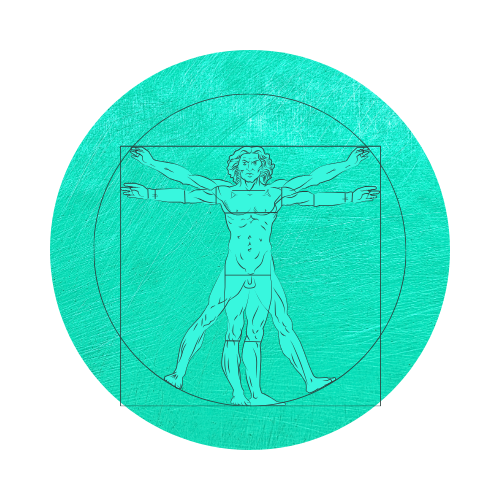
In the body: The almond shape of our own eyes. The shape of the mouth open in song. The opening of the birth canal. The body knows this form intimately.
Something To Try This Week
You don't need sacred geometry to be an intellectual exercise. Here is a simple way to work with the energy of the Vesica Piscis directly.
Sit quietly and bring to mind a relationship — with a person, with a part of yourself, with a situation — where you feel like you're experiencing opposition. Two things that seem to contradict each other. Two desires pulling in different directions. Two people who see things very differently.
Now, instead of trying to resolve the tension, try this: imagine each of those two things as a circle. Whole. Complete. Neither wrong. Let them move toward each other slowly until they overlap — just at the edges, just enough — and notice what appears in the space between them.
You don't have to force an answer. Just notice what's in the intersection. What do both circles share? What is the Vesica Piscis of this particular tension?
Often, what lives in that in-between space is more interesting than either side alone.
Next in this series: The Flower Of Life — a pattern so ancient it predates written history, found carved into stone on nearly every continent. We'll look at why this particular arrangement of circles became one of humanity's most widespread sacred symbols, and what it's actually showing us about the structure of reality.
Dive into your daily magic or journaling - without having to look anything up!
Discover the energies of each day of October 2026 including numerology, associated chakras, Sun, Moon and other astrological energies, recommended crystals, and a Tarot prompt for each day. This is the perfect companion piece for anyone who journals either for magic or for meditation. Only available until October 22, 2026 when the November Grimoire Companion launches.